Showing posts with label Psychological Horror. Show all posts

Sunday, 26 January 2014

Sound Deconstruction: Se7en

The sound I will be deconstructing is the non diegetic music from the opening sequence of 'Se7en'.


  • The sound is parallel to the unsettling images shown onscreen, reinforcing the psychological horror genre.
  • There is a high pitched, fast paced beat in the background that is present throughout the entire sound and is one of the most regular elements of the sound.
  • Throughout the sequence, a distorted squealing sound can be heard that is grating and will shock the audience listening.
  • Static can also be heard at various points during the sequence, which makes the music sound more disjointed and unsettling.
  • Before the music noticeably intensifies at 1:13, echoing synth notes can be heard. These sound like high pitched vocalising, which juxtaposes with the other harsh distorted noises present and creates a jarring effect.
  • At 1:13, electric guitar riffs are added to the music, which then intensifies as the sounds get louder and faster.
  • More electric guitar riffs can be heard towards the end of the sequence, which build in volume in a crescendo and give the music a frantic, disjointed feel.
This deconstruction is useful as we can use this as a reference when we create our final soundtrack for our film opening. This sequence uses shocking, distorted sounds to shock and unsettle the audience, which we can incorporate into our own soundtrack to make it more successful.

Monday, 16 December 2013

Genre Investigation: Psychological Horror

Orphan

'Orphan' (2009) is a psychological horror centred around a family of four and their newly adopted child, Esther.
Esther is different to the other children, which is, at first, endearing.
As the film progresses, the mother begins to suspect that Esther is more different than they had originally thought.

'Orphan' conforms to the typical conventions of psychological horror in a number of ways:

  • The main character, a wife and a mother, is, herself, psychologically damaged.
  • She is a recovering alcoholic.
  • She is also recovering from the loss of her unborn child.
  • A 'troubled' protagonist is very common in psychological horror films, as the film itself explores the mind.
  • It is also typical for the protagonist/victim to be female.
  • The film is largely set in a large house surrounded by woods.
  • This is a typical convention of psychological horror movies, as it separates the characters from the rest of the world and separates them from people that could help/save them.
  • The snowy scenery gives the setting a 'cold', bleak atmosphere, which reflects on the negative tone of the plot.

Typography


  • In the opening credits, the title of the film 'flickers' between a plain font and one that is splattered in neon paint.  This is a reference to something that happens later in the movie.
  • Furthermore, the font changes to another font which resembles 'scribbled' handwriting.
  • Coupled with the black background, it is clear to the audience that these are the opening credits to a horror film, as the typography is overall 'creepy' and sinister.

Opening sequence

  • The sequence begins in high key lighting, which brings a positive mood to the sequence.
  • The out of focus wide shot at the beginning creates a dreamlike atmosphere.
  • There are many close up shots of the female protagonist, and no one else's faces are shown till later in the sequence.  This tells the audience that she is going to be a key character in the film.
  • The red of the blood in contrast with the white hospital floor is a clear indicator to the audience that something isn't right.
  • The lighting then becomes low-key: the operating room is surrounded by darkness and dimly lit by top lighting.
  • All images seen are surreal, to make it clear to the audience that this is a dream sequence.
  • The sequence is made up of straight cut edits.
  • Each shot is very short and the frequently changing shots create an atmosphere of confusion, which reflects on the feelings of the protagonist.
  • This sequence also introduces the protagonist's psychological trauma to the audience.
  • A psychologically damages protagonist is a common convention in psychological horror.

Antagonist

  • Esther has the appearance of a normal girl, which makes her violent actions disturbing to the audience, as it is unnatural for a child to commit such crimes.
  • Although she looks like a normal child, she dresses in old fashioned clothing (often remarked on by other characters) and this marks her out as different, within the modern setting. 

  • Throughout the film, Esther, who is actually a grown woman, is in disguise as a young child.
  • It is common in horror movies for the main character to be disguised, as the audience does not know everything about them and this creates the fear of the unknown.
  • Esther is also psychologically disturbed, as demonstrated by the book she keeps with pictures of all of her victims: she is obsessive.

Music

  • The sequence above is a good example of the sound used throughout the film.
  • All diegetic sound is of children playing: this gives a happy atmosphere and contrasts with the contrapuntal non-diegetic sound:
  • The non-diegetic soundtrack is metallic and tuneless and has a negative tone.  These sounds increase in volume to create suspense and fear within the audience.
  • Some string instruments are used, playing in a minor key to contribute to the negative tone.
  • Low key lighting is used throughout the sequence to create fear within the audience, as they cannot see everything as some things are hidden in shadow.


Sunday, 15 December 2013

Minor Production Companies Research

Dark castle logo.jpg

Dark Castle Entertainment
DCE is a production house formed in 1999 with associations with Warner Bros. and Universal Pictures. Its primary focus when it was first formed was to recreate William Castle's horror films, but began creating original films after two remakes, and also produced films from other genres from 2008 onwards. The most recent horror films produced by DCE are:

  • The Apparition (supernatural) 
  • The Hills Run Red (slasher)
  • Orphan (psychological)
  • The Reaping (supernatural)
  • Return to House on Haunted Hill (supernatural)


File:Twisted Pictures.jpg


Twisted Pictures
Twisted Pictures is an American independent production company that specialises in producing horror films. It was founded in 2004 after the success of the first 'Saw' film and has since then become well known for producing the films in the 'Saw' franchise. Other horror films recently distributed by Twisted Pictures are:

  • Texas Chainsaw 3D (slasher)
  • Chain Letter (slasher)
  • Mother's Day (psychological)
  • Dead Silence (supernatural/slasher)

File:Platinum Dunes wikipedia logo.png

Platinum Dunes
Like Dark Castle Entertainment, Platinum Dunes specialises in horror films (particularly remakes). Founded in 2001 in Los Angeles, Platinum Dunes entered a first look deal with Paramount Pictures and since then has worked with Paramount on projects such as 'The Butcherhouse Chronicles' and the 'Teenage Mutant Ninja Turtles' reboot. Most recent horror films produced by Platinum Dunes are:
  • The Purge (horror/thriller)
  • A Nightmare on Elm Street (slasher)
  • The Unborn (supernatural)
  • Friday the 13th (slasher)
  • The Hitcher (horror/thriller)


Haxan Films
Haxan Films is an independent American production company headquartered in Florida. It is most well known for producing the famous horror film 'The Blair Witch Project', one of the most successful and critically acclaimed independent films of all time. Haxan Film's most recent releases are:
  • Lovely Molly (supernatural)
  • Seventh Moon (supernatural)
  • Altered (creature feature/science fiction)

This research is useful to the group as we need to include a production company in the opening credits of our film opening. We can use this research to decide which company we think is suitable for our genre (psychological horror) and so improve the quality of our opening by making it look more professional.

Sunday, 8 December 2013

Film Titles Deconstruction


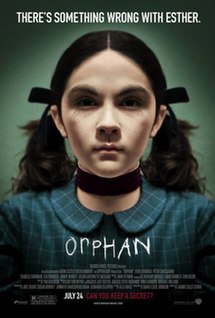
Orphanposter.jpgThe title 'Orphan' is short and to the point; it reveals a central plot point to the audience of who the main character in the film is, creating an enigma for the character. The typography is notable as it is a seriph font that looks like it was hadwritten by a child with juxtaposing upper and lowercase letters. The word 'orphan' is also associated to children and vulnerability and suggests that the film is about a child. The use of children as central characters in horror films is a frightening concept as their innocence is juxtaposed with the horror in the film, which could intrigue the audience further and encourage them to watch the film.

The Cabin in the Woods
CitwTeaserSmall.jpgThis title describes the location of the film and has connotations of isolation, suggesting that the horror happens in a secluded location which conforms to some conventions of the horror genre.The theme of isolation in turn makes the title sound sinister, establishing to the audience that this film is a horror. The word 'woods' in this context also has associations of dark fairy tales such 'Hansel and Gretel', where the villains live in the woods in isolation and catch their prey. This further reinforces the sinister sound of the title.

Shutter Island
Shutterislandposter.jpgThis title again establishes the location of the film and suggests a theme of isolation, as an island is isolated from mainland. This theme of being separated from others fits with the psychological horror elements of the film, linking to both the protagonist's mental state and how he is trapped in an isolated setting. The word 'shutter' also has connotations of something being hidden or covered up, which is a central part of the film's plot. 
Evaluation
All three titles have explicit links to different aspects to the films such as the characters or the setting. This gives enough information to the audience that they can establish the genre of the film and have some idea of what to expect from it, but doesn't give anymore information so the audience is encouraged to find out by watching the film. This research can be useful to my group as we are in the process of choosing a title for our film opening and can use this information to help us further. 


Orphan


Sunday, 17 November 2013

Typography Deconstruction


The main typography of this poster is white and so stands out from the rest of the poster because of the stark colour. The font is made up of mixed lower case and upper case letters looks like it was hand written by a child which informs the audience that the film is about a child and so is scary as children starring as antagonists in horror films is a frightening concept. This font juxtaposes with the rest of the text on the poster which is in all capitals and written in a basic, clean font. This contrast again draws more attention to the title and also emphasises that there is something wrong with the main character.


The title is typed in all capitals and is black in colour, standing out against the stark white background and following the monochromatic colour scheme of the poster. The text has been manipulated so there appear to be scratch marks running through the title, reinforcing the horror genre as the scratch marks have connotations of violence and mystery.


The title is orange in colour and contrasts with the dark greys and blues in the background, so it attracts the audience's attention straight away. The text is in all capitals and has been edited to look as if the letters have been trampled on and parts have been rubbed away, informing the audience that physical violence is a central part of the plot and so meets audience expectations of the horror genre.


Manipulating Text with Photoshop

For this practical task I used Photoshop CS6 to manipulate text.

I began by downloading a font called Assassins from the internet and opening it in Photoshop.

I opened the typography tool bar and adjusted the colour of the text from black to a dark burgundy colour to mimic the colour of dried blood so the text would look more sinister. I also adjusted the spacing of the letters so they were spaced slightly further apart than before.


I used a smudge tool to blur the bottom and top of the text to create contrast in the text, and also to make the text look more mysterious to conform to the conventions of pyschological horror.


Then I created a black and white gradient background with the gradient tool and used the dodge tool to adjust the colour of the middle of the text so it was brighter and the colour of fresh blood. I did this to create more contrast and make the title stand out more. 

I then experimented with different text effects to manipulate the text further, such as creating shadows around the letters or making the text look more textured


Evaluation
 
  • I found this task a little difficult as I have little experience with Photoshop and editing software so I was reliant on online tutorials and experimenting with the tools until I found the ones that were the most suitable for this task.
  • To improve next time I will familiarise myself with editing software so I will be more experienced with manipulating text and creating typography.


Sunday, 10 November 2013

Scrapbook Practical Task

For my practical task I had to create a page from a scrapbook kept by a killer who stalks his victims and then records them in his book.


To create this I used:

  •  2 photos of young women I found on the internet 
  • 2 photos of women inflicted with severe wounds (special effects) which were also from the internet 
  • 2 locks of different coloured hair I cut from dolls 
  • Dark red nail varnish
I stuck the photos to a piece of card in a particular order; on the left hand side were the photos of the normal young women, while on the right hand side were the photos of the women with the wounds. This was so the photos would look as if they were of only two victims- a 'before' photo of the victims and an 'after' photo. I also glued the different pieces of hair underneath the photos of the 'victims', as if the killer had kept them as souvenirs. To finish, I used the nail varnish as a fake blood substitute to create blood splatters and a thumbprint (another souvenir for the killer) and wrote details around the photos such as the victim's age, weight and the date of their death, as a stalker/killer would be organised in their recordings of their victims.


'Shutter Island' Sound Deconstruction

The scene I will be deconstructing from 'Shutter Island' is the scene in which Teddy creates a car explosion and hallucinates as he does so:

The sequence begins with non diegetic background music comprising of sinister sounding deep wind and string instruments with high synthesised notes that make the music sound disjointed. This is accompanied by diegetic sounds such as Teddy's feet rustling leaves as he runs and his heavy breathing. These sounds create an uneasy atmosphere for the audience which is appropriate for this scene as it shows Teddy's unstable mental state.When Teddy gets in the car and hallucinates his dead wife talking to him, the diegetic sound of his heavy breathing from exertion is emphasised, as his slamming of the car door when he gets out. These noises are punctuated with the background string instruments swelling out momentarily into a low, intense note, creating tension and surprise. When a long shot of the ominous lighthouse is shown, the same intense swell of music is heard, clearly telling the audience that the lighthouse is a bad place and creates more tension within the scene. As Teddy talks to the hallucination of his wife, making an emotional admission, the non diegetic string music swells once more, this time accompanied by a non diegetic rushing sound similar to wind blowing. In the following scene when Teddy hallucinates a little girl holding his wife's hand in front of the car, all diegetic sound is silenced; the only sound heard is the disturbing rushing sound again which overlaps disjointed synth notes that vary from high to low. The diegetic sound of Teddy breathing heavily in panic is then made audible again, followed by his whisper of 'No'- this creates a sense of foreboding for the audience and fulfills audience expectations that something bad is about to happen. The non diegetic roaring sound builds before the car explodes, emitting a loud banging sound accompanied by an intense low note created by wind instruments that make the scene feel more dramatic and satisfies the audience expectation of a bad event taking place.

Sunday, 27 October 2013

Genre Investigation: Shutter Island

'Shutter Island' is a psychological horror directed by Martin Scorsese which is based around an U.S Marshal investigating a psychiatric facility in Boston Harbour. 

There are numerous ways in which the film 'Shutter Island' conforms to the common conventions of psychological horror, such as:

  • The main character often being an detective as well battling with their own personal issues. 
Here in the film the main character, Edward 'Teddy' Daniels is a U.S Marshal who is investigating Ashecliffe Hospital for the criminally insane for a woman who murdered her own children had gone missing. The protagonist, Daniels, also is struggling with the lose of his wife, Dolores.


  • The struggle between illusory and reality
The protagonist struggles to differentiate between whether he is dreaming/hallucinating or whether it is real life. Within in the film he sees his deceased wife and 'children' in real life situations.

  • Plot Twists and Deceptive Games 
Within 'Shutter Island' there are several plot twists and deceptive games from the woman who went missing suddenly appearing to the antagonist trying to convince Daniels that he is a patient in the psychiatric facility telling him how he is the most dangerous patient of them all for killing his wife after she killed their children by drowning them in the lake.

Setting


  • The film 'Shutter Island' is set in Boston Harbour
  • Severe storm giving pathetic fallacy
  • Dark, dull grey skies gives an negative outlook to the plot
  • Typical of psychological horror films to be secluded from outside world
Typography 


Sound


Editting


Wednesday, 9 October 2013

Practical Source of Inspiration

Inspiration


Here, I have chosen the opening from 'American Horror Story' as my inspiration in terms of editing and mise en scene. Kyle Cooper, the maker of the opening sequence has perfectly captured an unsettling and intimidating atmosphere. I think this opening sequence would be perfect to inspire our film opening if we opted for the genre of Psychological Horror.

Experimenting

Inspired by the 'American Horror Story' opening I created a response with a similar theme to the opening. I set the sequence in my garage as it fitted with the dark, eerie atmosphere of the one in which the opening was set. In the sequence I used a Canon digital SLR camera to record and tripod, I also used the torch on my iPhone to create a flashing effect just like the one in the 'American Horror Story' opening. In terms of mise en scene I used various props such as fake blood, a saw and a biblical hanging piece which I found to create a very chilling ambience as though something sinister had happened e.g. a murder. In the process of this task I experimented with different camera angles and movements such as panning, high angles, hand-held etc. I feel that the opening of 'American Horror Story' will be of great inspiration for giving a very mysterious and strange quality to our film opening if we were to make a psychological horror film. Overall in terms of the editing I used simplistic straight cuts as it was the predominant one used in the opening. I do feel that this response could have been improved due to it being slightly rushed.


My Strengths

My strengths that I can use to help with my media coursework is knowledge of using a camera and knowing angles would be best suited. As well as this I can provide creativity and imagination, for example to help create imaginative story lines and come up with different techniques to take something quite boring and turn it into something quite interesting. Another strength would be my basic knowledge of using editing software and music software.